
Take Care
Or: why Social Infrastructure is operating risk in sovereign clothing.
Social infrastructure is sold on one idea: that the government stands behind it. Special educational needs and disabilities (SEND) schools, care homes, children’s residential homes, supported housing all fall under the social infrastructure umbrella. Local authorities have a statutory duty to fund placements. Demand does not follow the economic cycle, and the tight supply is exactly the kind of “thematic tailwind” investors get excited about. The pitch, in effect, is that you are lending against something close to sovereign risk with real estate collateral to boot.
While this story is generally true, it doesn't always survive contact with reality. A statutory duty to provide a service is not a guarantee of a cash flow to a borrower. The state underwrites the outcome: that a vulnerable person is housed and cared for. It does not underwrite your loan, your landlord’s rent, or your recovery. The gap between those two propositions is where social infrastructure credit is made or lost, and it is consistently the part that receives the least underwriting attention.
This note digs into that gap. We explore why social infrastructure deals are won or lost in the trenches more often than in Whitehall, and what good structuring and underwriting discipline looks like.
A note on intent: we write the Credit Observer to sharpen our own thinking and to hold ourselves accountable to the standards we set. This article is not a criticism of any specific sector or investment strategy. It is merely a reminder that in times of abundant capital it is easy to get carried away. We welcome feedback and the debate.
Much like 10k steps a day, our discipline is easy to state and hard to apply consistently. We underwrite the operating business purely as that: an operating business with no backstop at all. We then treat the government’s involvement as a floor under the social outcome rather than under our recovery. In practice that means looking at each identified failure mode and verifying we have structural protections against it. If not, we don’t proceed.
Below is the cheat-sheet for how we underwrite these assets. The rest of this note takes each row in turn.
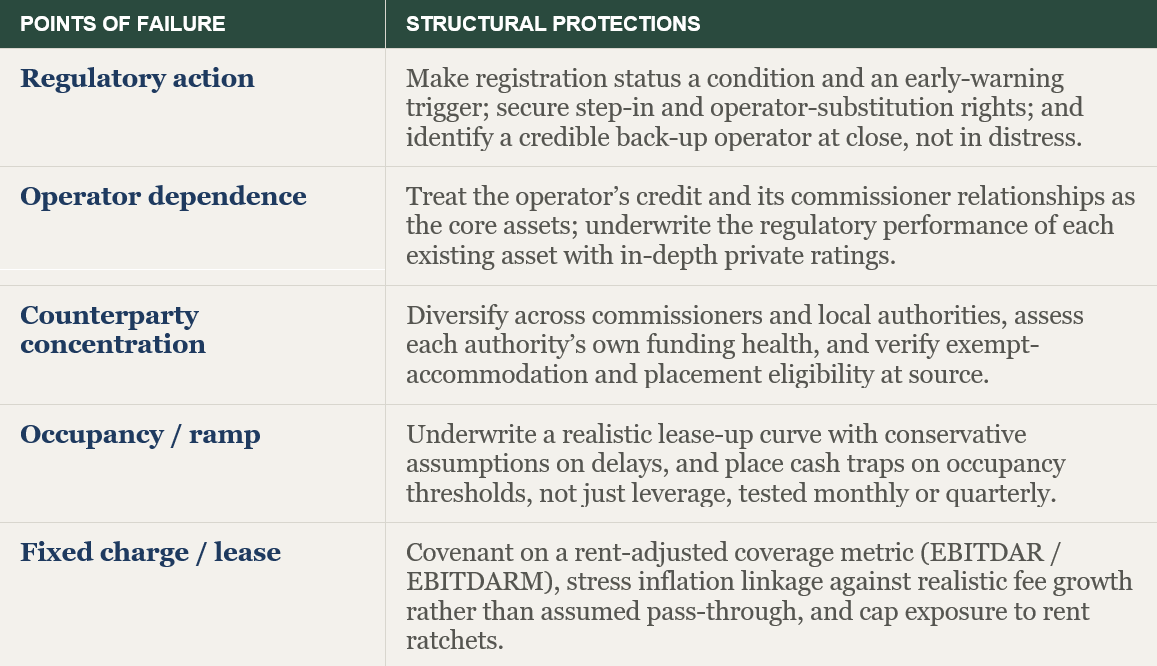
In short, we apply the ordinary discipline of operating business credit, applied to assets that are routinely sold as something safer. The protections are not there to second-guess the social mission. They exist so the financing survives long enough to keep serving it.
We start with the regulator, because it can both be the beginning and the end of an operation.
A Licence to Trade
In most regulated sectors, the regulator sets the rules and adjusts prices at the margin. In social infrastructure, the regulator decides whether the business operates at all. The Care Quality Commission (CQC) for care assets, Ofsted for education, and the Regulator of Social Housing must sign off on any new property before it opens, and each can order a trading one to stop. The risk is binary, a switch rather than a dial: a care home in special measures cannot fill new beds, and a children’s home that loses its registration stops trading.
The Hesley homes in Doncaster are a stark warning. Concerns were logged more than a hundred times internally over three years and Ofsted itself was alerted dozens of times, but the homes retained their 'Good' rating throughout. Then, in March 2021, they closed. For a lender, this is the regulatory risk in its purest form: not a dial that turns gradually, but a lagging indicator that shows green until the day the switch flips. Your quarterly covenant package would not have seen that coming.
It follows that protection cannot rely on ratings alone (sound familiar?). We still covenant on a minimum regulatory rating, but we treat it as the backstop, not the tripwire. The tripwire is set earlier: material concerns or complaints bring the borrower to the table on short notice. And because even that can lag, the structure assumes the switch can flip anyway: a credible back-up operator is identified at close, not in distress.
No Operation, No Asset
It is tempting to treat social infrastructure as real estate with a public-sector tenant. It is closer to an operating business with a building attached. The value sits in the registration, the trained workforce and the live commissioner relationships - not in the bricks and mortar. A care home without a CQC registration, a staffed rota and a referral pipeline is worth materially less than the same building with them.
The recovery thesis that works for commercial property - sell it or re-let it - does not transfer. Enforcement means running or replacing an operator under regulatory scrutiny, not flipping an asset.
The Dash review found the CQC carrying a serious backlog of registration applications, with more than half of new provider submissions arriving incomplete. The regulator’s response, from February 2026, was to return or reject any incomplete application on receipt, with each resubmission treated as a new application at the back of the queue. For a development lender the consequence is dire: an unpriceable counterparty now sits on the critical path between practical completion and the first pound of revenue. A finished, staffed home awaiting registration earns nothing. The lease-up curve does not start at practical completion. It starts when registration arrives.
The stock of existing ratings has decayed in parallel. Under the risk-based inspection model a rating persists until the regulator returns, and the regulator has not been returning. In one recent sample of poorly rated care homes, four in ten had not been inspected for more than three years, and nearly one in ten for more than five. The CQC’s own catch-up programme now prioritises services never assessed since registration and ratings more than six years old: cohorts that should not exist. A "Good" rating may describe the home as it stood before the pandemic, under a different manager, a different rota and a different acuity mix.
For loan documentation the consequences run in both directions. A covenant requiring the borrower to maintain its registration and rating is, across much of the sector, anchored to a stale reading: technically satisfied and informationally empty. And the correction will not arrive gradually. The CQC has committed to publishing 9,000 assessments by September 2026 and is running well ahead of last year’s pace. Years of deferred inspections will land in a compressed window, crystallising downgrades, and with them covenant defaults, that reflect deterioration long since embedded in the business.
Our discipline here is twofold. Treat the certificate as a dated document and verify the registration and rating position at source with private assessments. And work with operators who have at least five years of operating history and a professional team dedicated to regulator and commissioner relationships, so registration arrives on time.
The regulator decides whether you may trade. Proper underwriting starts with whether you trust the occupancy assumptions.
Occupational Hazard
The statutory money is real, but it is attached to the resident, not the building and not the borrower. Housing benefit, a placement fee, an education, health and care plan (EHCP) funded place: each is paid for an occupied, eligible bed or place. Lose the resident or lose the eligibility, and the “guaranteed” income does not get paid.
First Priority Housing Association is an example. It was a small registered provider whose income was almost entirely a cut of the housing benefit it collected, about as close to government money as the model gets. It grew quickly on long, inflation-linked leases from property investors, who were paid out of that same benefit stream. In early 2018 it came within touching distance of insolvency. The proximate cause was not a funding cut. It was occupancy - the lease book barely worked even without vacancies.
The listed market ran the same experiment at scale, with the government-backed claim written into the marketing of social housing REITs, which helps explain why the shares initially priced at premiums to asset value. The Regulator of Social Housing spent years issuing non-compliance judgements against the thinly capitalised registered providers on whose long leases these REITs depended for rent. The sector's persistent discounts and short-seller attacks traced back to the same realisation: the rent was due from a private registered provider, not the government.
Home REIT was the starkest case. It raised £850m of equity to house the homeless, on leases its prospectus described as "ultimately funded via central government income" (source: Home REIT plc, Prospectus, 22 September 2020, Part 2 "Investment Opportunity, Investment Process and Pipeline - Competitive Advantages," p. 50). Within two years the model had inverted: much of the portfolio proved ineligible for the exempt accommodation status the income depended on. Tenants representing a third of the book, predominantly private registered providers, went into liquidation, and rent collection fell at one point to a fraction of the contracted rent. The company is now in wind-down; in January 2026 the NCA and Serious Fraud Office arrested six people in connection with a suspected £300m fraud. The housing benefit was real and the need acute. None of it reached the fund, because ineligible properties earn no benefit and insolvent tenants pay no rent. "Government-backed" described the sector, not the transaction.
The lesson is not that supported housing is uninvestable. It is that you are not lending against a sovereign-style payer with a coupon. You are lending against a lease-up and occupancy curve dressed as one. That curve has to be underwritten with the same scepticism you would apply to any operating business, because that is what it is.
Private Pay Premium
In care homes, the best fees in the building are not paid by the government. The state here is not merely a conditional payer; it is a bad one. The private resident, who owes nobody anything, pays the premium that covers the fixed charges, and operators target that premium deliberately. Colliers’ Q1 2026 Healthcare Snapshot puts the gap in valuation terms: majority local-authority homes can trade 5 to 7 turns of EBITDARM below a newly developed, majority private-pay home.
Credit should follow that arithmetic. The most valuable care home asset is not the one with the largest slice of statutory income. It is the purpose-built home in an affluent catchment: a predominantly private-pay roster, favourable supply and demand (which implies genuine pricing power), and fee growth tied to the wealth of its residents rather than to a spending review. The operators that have grown through every funding squeeze are the ones the commissioner barely touches. The conclusion is uncomfortable for the sector’s marketing but essential to its underwriting: private-pay income, unmandated, unguaranteed, fully discretionary, is a more valuable asset than what a local authority pays.
Occupancy and payer mix are the revenue side. We turn to the biggest cost behind the operating leverage: rent.
The Rent Also Rises
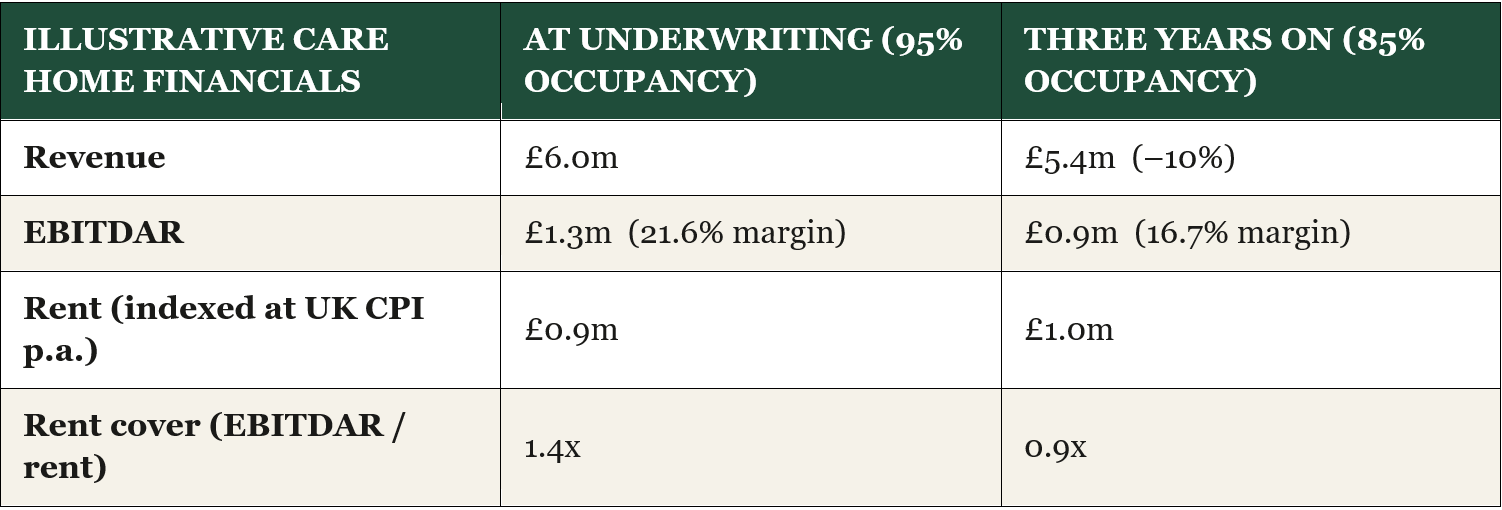
The fixed cost problem is the oldest failure mode in the sector, and it has already taken down large players. Southern Cross, once the country's largest care-home operator, was built on sale-and-leaseback: it sold its freeholds and leased the homes back on rents that rose every year. When occupancy slipped from the mid-90s to the low-80s, the inflation-linked rent did not fall with it. The operator was reduced to deferring, then unilaterally cutting, the rent it owed to stave off mass closures, and the business failed. Four Seasons, which had absorbed many of those same homes, went the same way in 2019.
The Regulator of Social Housing has made the same observation, repeatedly flagging that full-repairing-and-insuring leases load a disproportionate share of risk onto the operating tenant, which is often thinly capitalised and over-reliant on receiving a small cut from the housing benefit.
The structural point is that rent is a fixed cost senior to almost everything. The honest coverage metric in a Propco-Opco structure, the prevalent structure in the industry, is rent-adjusted EBITDAR, or EBITDARM once management charges are stripped out. Adjusting for intra-group rent and management charges, which can be significant once assets stabilise, gives the cleanest apples-to-apples read of the assets themselves. The table below illustrates what fixed rent does to a typical care home when occupancy falls 10 points.
And finally, if the thesis works anywhere, it should work in SEND schools. We end there.
Needs Must
If any sub-sector should vindicate the government-backed thesis, it is SEND schools. The number of children with an EHCP has nearly tripled in a decade to more than 700,000. The plans are statutory, individually enforceable, and frequently awarded at tribunal over the council's objection. Around £1.8bn a year of high-needs funding flows to independent special schools, with individual placements running well into six figures. This is the closest thing the sector has to mandated, growing, price-insensitive government demand.
All of it is paid to the operator: per pupil, per term, for education actually delivered by a registered school with a full staff rota and a live Ofsted rating. There is no property-level version of this income. The building, on its own, earns nothing.
A structure we reviewed recently carved the freeholds out of an operating group, wrote a long-indexed lease back to the schools, and offered the rent to lenders as government-backed income. Trace the cash and the claim dissolves. The rent is the EHCP fee stream, passed through an Opco that now carries a fixed charge, and the Propco’s “backing” is wholly contingent on that Opco staying registered, staffed and filling places. Nothing about the state’s involvement has attached to the property; the structure has simply stacked a lease claim on top of the operating risk while surrendering control over it. Southern Cross’s architecture, transplanted into a classroom.
The cure is not to avoid Propco/Opco structures - but rather hold security over both boxes, linking the rent to the trading performance it depends on, and underwrite the whole business as one credit.
The state pays for services, not for buildings. The only way to receive its money is to take the operating risk that earns it: directly, or by underwriting the tenant as though you held it.
How Deals Die
Put the failure modes together and a pattern emerges. The deals die in the same way: the distance between “the state will always need this”, which is true, and “therefore this asset will be paid”, which is not. The ramp runs longer than modelled. A vacancy rate surprises to the downside. A registration lapses or is removed. Rent grows while occupancy lags. None of these are macro events – they are all down to operations.
This is not a story about a handful of badly run providers. The Competition and Markets Authority concluded in 2022 that the UK was in a dysfunctional children’s social care market, with the largest providers carrying very high leverage and a real risk of disorderly failure; the three biggest posted combined losses of nearly £184m in their 2023 accounts. When the competition authority is warning about leverage on one side of the sector and the housing regulator about lease-based fragility on the other, distress is the working assumption a lender should start from.
So Long, Take Care
Slapping "infrastructure" on an asset class is a time-tested way to attempt to lower its cost of capital and open an exit to a new buyer universe at an “infra multiple”. Readers of our “Fibre Indigestion” previous Observer have seen the move before. The label might change the buyer universe; it does not change the risk. None of this means the opportunities outside core infrastructure are bad. Some of the best risk-adjusted returns we see sit exactly there. But they must be pursued with domain expertise and caution in equal measure.
The statutory duty that anchors social infrastructure is simultaneously the most reliable feature of the sector and the most misread. It guarantees that the service continues. It does not guarantee your coupon, your refinancing, or your enforcement recovery. Underwrite the operating risk, price it honestly, and the government’s role becomes what it is: a genuine floor under the social outcome, and a margin of safety you did not pay for, rather than the security you mistook it for.
Vertis regularly originates and underwrites operating assets in this sector, but our deliberate focus is typically earlier: financing development, where the risk-adjusted returns are better. We fund the build over 18 to 24 months, with a take-out within months of practical completion and registration. The supply is needed. Knight Frank reported this year that 79% of care home stock is over 20 years old. We structure the construction risk on simple, quick builds with experienced operators, and we underwrite the operating performance for the downside where the refinancing takes longer.
SIX QUESTIONS FOR DAN SMITH, FOUNDER & CHIEF EXECUTIVE OFFICER OF BROADWOOD CAPITAL

Vertis: In Care Homes – there has always been a debate about private-pay versus local-authority mix. How do you think about the right balance in a single home, and how does it change the exit?
Smith: Broadwood's focus is on funding the development of predominantly private-pay care homes, and our underwriting is typically built on the assumption that a home will stabilise with no less than 65-75% private-pay residents, often higher. That said, we like homes that aren't 100% private pay - we think it's important that a home retains places for local authority residents too. It's not unusual to see a higher proportion of local authority residents at opening, with the private-pay share increasing as the home moves towards stabilisation and eventual exit. This matters for valuation: homes with a greater proportion of local authority residents, who sit on lower average weekly fees, tend to operate on tighter EBITDA margins, so all else being equal, their stabilisation value will be lower than a comparable home with a larger private-pay base. Because our underwriting assumes a high level of private pay, we monitor fill-up closely throughout the loan to make sure there's no adverse impact on exit valuation and refinance.
Vertis: Some investors fret that development financing is “riskier” and some look to avoid it in general. What have your experiences been and what has been the hardest part when convincing investors of the asset class?
Smith: Funding developments does carry a different - and greater - risk and reward profile than investment lending, and it demands real knowledge and experience; development finance is a specialist area. We have a demonstrable track record here: personally, I've completed over £1bn across roughly 100 development finance loans, around 75% of them in the later living sector, and that depth of experience is what allows us to mitigate construction risk while still delivering strong investment performance.
Investors are often instinctively cautious about development finance, and the main challenge is persuading them there's a fundamental difference between financing a highly specified, high-rise tower on a tight site and financing a two-storey care home. We often put it simply: a care home is really just a very large, 80-en-suite-bedroom house with six living rooms and a big kitchen. Care homes are typically two to three storeys, built from brick, tile and timber - the construction itself is not complicated. That said, at the moment there's heightened focus on material prices, labour availability and contractor failure, which makes it even more important to carefully underwrite the contractor, the professional team, and the procurement and delivery strategy, and to make sure the financing structure fits the development. This is where Broadwood's expertise sits. It also means the manager needs a genuinely detailed understanding of every facet of construction finance - not just the build itself, but the statutory side too: planning conditions, highways, utilities and other non-construction requirements, which are often overlooked despite being just as important.
Vertis: This note argues Propco /Opco structures can dress operating risk up as property income. Broadwood lends regularly into these structures. What separates the ones you'll finance from the ones you won't?
Smith: We regularly finance sponsors who both develop and operate, and we actually see that as a strength rather than a red flag: operators understand what it takes to run a home successfully, and that knowledge feeds directly into design and development decisions. What we always look for is a sponsor with a genuinely successful operating track record, built up over a number of years and across multiple homes. As part of our underwriting, we review the sponsor's existing open homes, their CQC reports, and fully underwrite the operating business itself - not just the development plan.
Vertis: How has the asset class fared in the last 4 - 5 years off the back of interest rate increases and inflation uncertainty?
Smith: The sector as a whole has performed well and is increasingly being viewed through an institutional lens - you can see that in the volume of investment activity over the past 24 months, most notably Welltower's (the US REIT) acquisitions in the space. Some large institutions still keep care "outside of policy," but that's starting to shift, and care is now firmly back on the radar for many investors. The underlying demographics remain compelling, and there's a persistent supply-demand imbalance, with roughly as many homes closing as opening.
We have seen fewer new starts in recent years, driven by higher interest rates, land prices and construction costs, though that's begun to stabilise and we're seeing both existing developers and new entrants return to the market. The financing model has shifted too - forward funding was very active until rate rises and construction cost concerns made it less common, and we're now seeing fewer homes built on that basis. On the cost side, inflation has clearly pushed up operating costs, compounded by government interventions like minimum wage increases, National Insurance rises and restrictions on overseas workers. Operators have responded by passing these costs on through higher fees, and the increase in average weekly fees over recent years bears that out.
Vertis: In development financing, your loan exit is to be taken out by a “stabilisation lender”. Over the last 10 years, how has bank take-out appetite developed to refinance these assets on practical completion and registration?
Smith: Over the past two to three years in particular, a lot more lenders have entered the market, drawn in by a strengthening sector and by margins that remain relatively attractive as more traditional core sectors face downward pricing pressure. There's now a healthy market for refinancing newly built homes once they're completed, registered and trading - we're regularly seeing LTVs of 65-70%, sometimes higher, on competitive margins. The lender base providing these stabilisation loans is broad and active: high street banks, institutional lenders (insurance companies and pension funds), challenger banks and alternative lenders are all participating.
At Vertis we are building the leading credit platform for Europe’s Lower Mid-Market. We are doing this across cash-flow lending via our strategic partnership with DunPort Capital Management and asset-backed lending via Vertis Capital Solutions.
Published by the Investment Team